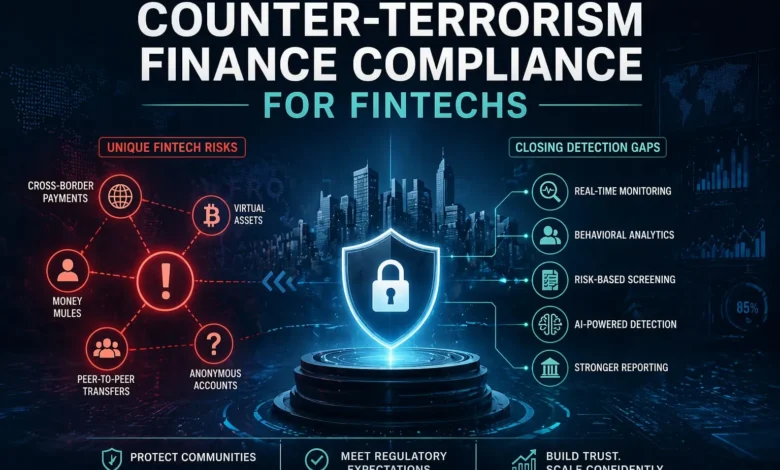
Fintech companies have spent the last decade making financial access faster, cheaper, and more global. Instant cross-border transfers, digital wallets, crypto on-ramps, and embedded payments have opened financial services to hundreds of millions of people who previously had none. That same openness has also made fintechs one of the most attractive entry points for terrorist financing in the modern financial system.
This is not a hypothetical risk. The FATF’s 2023 report on terrorist financing trends specifically identified money services businesses, payment platforms, and neobanks as higher-risk channels due to their speed of onboarding, transaction velocity, and limited legacy oversight infrastructure. For compliance teams at growth-stage and scaling fintechs, the gap between regulatory expectation and actual program maturity is often wider than leadership realizes.
What Makes CTF Different From Standard AML Compliance
The instinct to treat counter-terrorism finance (CTF) as a subcategory of AML is understandable. Both programs use the same core tools: transaction monitoring, KYC verification, sanctions screening, and suspicious activity reporting. Both sit inside the same regulatory framework in most jurisdictions. In practice, however, the threat profiles are different enough that a pure AML lens will consistently miss CTF-relevant activity.
Money laundering is about disguising the origin of criminal proceeds. Terrorist financing is often about redirecting legitimately sourced funds toward violent ends. A salaried employee who makes regular savings deposits and then begins sending small amounts to a contact in a conflict-affected region may show no traditional AML red flags at all. No structuring, no large cash deposits, no high-risk business activity. The risk is entirely in the destination, the network, and the pattern, not the source.
This distinction changes what effective detection looks like. AML programs are optimized to find anomalies at the point of origin. CTF detection requires equal attention to the destination, the beneficiary network, and the behavioral trajectory of the account over time.
For fintechs that have built compliance programs primarily to satisfy AML requirements, retrofitting CTF capability is not just a policy exercise. It requires rethinking what signals the monitoring system is actually looking for.
Why Fintechs Face Disproportionate CTF Exposure
Traditional banks built their compliance infrastructure over decades, often under direct regulatory supervision with significant resources allocated to financial crime. Fintechs, by contrast, frequently launch with minimum viable compliance stacks and scale their programs reactively as regulatory pressure increases. That sequencing creates structural gaps.
Three characteristics make fintechs particularly exposed to CTF risk.
Speed of onboarding. Many fintechs have reduced account opening to minutes, which is a genuine competitive advantage and a genuine compliance risk. When a full KYC process takes place in under three minutes with no human review, the quality of beneficial ownership verification and adverse media screening is necessarily limited. Terrorist operatives know this, and lighter onboarding processes are specifically identified in FATF guidance as an exploitation vector.
Cross-border transaction capability. Fintechs that offer international transfer services are processing payments to jurisdictions that carry elevated CTF risk. The speed and low cost that make these services valuable to legitimate remittance users also make them attractive for moving small amounts of money to conflict-affected regions without drawing attention.
Fragmented compliance data. Many fintechs operate across multiple products, payment rails, and jurisdictions using different underlying systems. When transaction data, KYC records, and alert histories sit in separate environments that do not communicate with each other, analysts reviewing a suspicious account are working with an incomplete picture. This is exactly the kind of structural fragmentation that legacy and point-solution compliance tooling tends to produce over time. Connections that would be visible in a unified view stay hidden across disconnected systems, and the CTF signals that depend on cross-account pattern recognition simply do not surface.
What Terrorist Financing Red Flags Actually Look Like in Digital Payments
The challenge with CTF detection in digital payment environments is that many of the most diagnostic behavioral signals look ordinary in isolation. It is the combination of factors, and the trajectory of account activity over time, that distinguishes legitimate behavior from suspicious patterns.
Red flags that compliance teams should be calibrating their systems to catch include:
- Small, frequent transfers to a consistent beneficiary in a jurisdiction with active conflict or designated terrorist group presence, particularly where the sender has no obvious personal or business connection to that location.
- Rapid account funding followed by immediate outbound transfers, leaving minimal balance retention. This pattern suggests the account is being used as a pass-through rather than for genuine financial activity.
- Multiple senders funding a single recipient account, where the senders have no apparent relationship to each other. This can indicate a coordinated collection effort funneling toward a single individual or organization.
- New accounts with limited transaction history that suddenly initiate international transfers, particularly to high-risk destinations.
- Mismatches between stated account purpose and actual transaction behavior. A business account opened for e-commerce that is primarily receiving peer-to-peer payments from individuals warrants closer scrutiny.
- Use of multiple accounts across related devices or IP addresses, suggesting coordinated management of accounts that appear unconnected on the surface.
None of these signals is automatically indicative of terrorist financing. Each has innocent explanations. What matters is the system’s ability to surface combinations of these signals for human review, rather than evaluating each transaction in isolation.
How Cryptocurrency Complicates the CTF Picture for Fintechs
Fintechs with crypto functionality carry an additional layer of CTF exposure that requires specialist capability to manage. The early assumption that cryptocurrency was primarily a tool for financial crime has been largely revised. Blockchain transactions are publicly recorded and, for major chains, highly traceable. Several high-profile terrorist financing prosecutions have relied on blockchain analytics as primary evidence.
The genuine complexity comes from privacy-enhancing tools: mixers, coin swap services, and privacy coins that break the transaction trail in ways that standard blockchain analysis cannot easily follow. When funds move through these mechanisms before arriving at a fintech’s on-ramp, the connection to the original source is obscured.
For fintechs offering crypto on-ramp or off-ramp functionality, effective CTF compliance requires:
- Integration with a specialist blockchain analytics provider capable of risk-scoring wallet addresses against known illicit activity databases.
- A clear policy on which wallet types and transaction histories the platform will accept, including whether funds that have passed through mixers or privacy coins trigger automatic review or rejection.
- Transaction monitoring that connects on-chain activity with off-chain account behavior, so that a customer’s crypto transaction patterns and their fiat transaction patterns are assessed together rather than separately.
Treating crypto compliance as a standalone function, separate from the broader CTF monitoring program, is one of the most common gaps regulators identify in fintech examinations. AI-powered systems that embed explainable reasoning into alert triage, and surface the connection between on-chain and off-chain activity within a single investigation workflow, close this gap considerably faster than manual analysis ever can. But the AI has to be built for auditability, not just detection speed. Compliance teams need to be able to show regulators exactly why a flag was generated and what the analyst did with it.
The Role of Watchlist Screening in a CTF Program
Sanctions and watchlist screening is the most direct CTF tool available to financial institutions. Designated terrorist organizations, associated individuals, and affiliated entities appear on lists maintained by OFAC, the UN Security Council, the EU, and national regulators. Screening customer and transaction data against these lists is a legal requirement in most jurisdictions, and failures to screen or to screen accurately have resulted in significant enforcement actions.
The operational challenge is keeping screening current and making it comprehensive. Designated entity lists are updated frequently, sometimes multiple times per week during periods of active geopolitical instability. Batch screening processes that run daily or weekly create windows where newly designated individuals can transact without detection. Real-time screening against continuously updated lists is the standard for institutions serving higher-risk customer segments or high transaction volumes.
Equally important is the quality of the screening logic. Fuzzy matching algorithms need to be calibrated to catch name variations, transliteration differences, and common aliases without generating alert volumes that overwhelm the review team. A screening system that catches every potential match is only useful if the institution has the analyst capacity to work through what it produces. AI-assisted screening that explains why a match was flagged, and ranks alerts by confidence level with visible reasoning, gives analysts a meaningful productivity advantage over systems that produce raw match lists without context.
Understanding how AML compliance and CTF screening work together as an integrated defense, rather than parallel programs, is foundational to building a program that holds up under regulatory scrutiny. Flagright’s detailed breakdown of AML compliance in the fight against terrorist financing covers the regulatory framework and detection requirements that financial institutions need to operationalize, particularly for fintechs and neobanks navigating CTF obligations for the first time.
What a Mature CTF Program Looks Like for a Scaling Fintech
Building CTF capability does not require a compliance team the size of a major bank. It requires the right architecture and the right priorities. For a scaling fintech, the most impactful investments follow a clear sequence.
Start with a genuine CTF risk assessment. This is separate from a general AML risk assessment. It should identify the specific products, geographies, customer segments, and payment corridors that carry elevated CTF exposure for the business model. The risk assessment drives everything else: what monitoring rules get built, what screening thresholds get set, and where enhanced due diligence applies.
Build monitoring rules that reflect CTF typologies, not just AML patterns. Many off-the-shelf monitoring configurations are designed around money laundering red flags. A CTF-aware program adds rules that specifically target the small-amount, high-frequency, network-based patterns associated with terrorist financing, calibrated to the institution’s transaction volumes and customer profiles. This is also where the limitations of rigid, legacy compliance platforms tend to surface most clearly. Institutions that cannot customize rule logic without lengthy vendor development cycles will consistently lag behind the threat.
Invest in human review capacity proportionate to alert volume. Automated systems identify candidates for review. Human analysts make the judgment calls that determine whether activity warrants a SAR filing or escalation to law enforcement. Specialized investigation tooling like AI Forensics, which deploys purpose-built AI agents directly inside the case management and alert investigation workflow, can surface recommended next steps, relevant typology matches, and connected entity information at a pace no purely manual review process can match. The key requirement is that AI recommendations are explainable and overridable, not black-box outputs that analysts have to accept or reject without understanding the reasoning.
Document the reasoning behind every material compliance decision. Regulators reviewing a CTF program want to see not just that decisions were made, but that they were made rationally and consistently. A system that produces well-documented analyst notes, clear escalation trails, and defensible SAR narratives is significantly more resilient under examination than one where decision-making is informal or inconsistently recorded.
This is the standard that enterprise-grade compliance infrastructure needs to meet. Flagright is purpose-built for AI-native financial crime compliance at this level of operational rigor: a unified platform trusted by more than 100 financial institutions across 30+ countries, bringing together transaction monitoring, watchlist screening, case management, and governance in a single audit-ready environment. For institutions that have outgrown fragmented point solutions or need to replace legacy tooling that cannot flex to CTF-specific requirements, it offers the customizability, AI explainability, and enterprise support that sophisticated compliance programs demand. AI capabilities are embedded directly in alert investigation and system optimization workflows, with human oversight built in at every decision point rather than bolted on as an afterthought.
The fintechs that will carry the most regulatory and reputational risk over the next five years are not the ones that ignored CTF entirely. They are the ones that checked the compliance box with frameworks built for a different threat profile and assumed that was enough.
Terrorist financing is a detection problem before it is a reporting problem. Institutions that invest in the detection layer, with monitoring logic, screening quality, analyst capability, and AI that can show its work, are the ones that will find meaningful activity when it exists. The rest will find out after the fact, which is the worst possible time to discover a gap.