The Marathon Student: How to Maintain Focus During Massive Academic Projects

University life is often described as a sprint—a mad dash from one lecture to the next, punctuated by weekly readings and short quizzes. However, when you reach your final years or enter a postgraduate program, the landscape changes. The “sprint” turns into a grueling marathon. Whether it is a dissertation, a final-year thesis, or a comprehensive research project, these massive academic tasks require a level of mental endurance that many students haven’t had to build yet.
Staying focused on a single topic for months on end is a psychological battle. It is easy to start with a burst of inspiration, only to find yourself staring at a flickering cursor three weeks later, wondering where your motivation went. To survive the long haul, you need more than just coffee and highlighters; you need a strategic approach to cognitive energy and project management.
The Anatomy of the 5,000-Word Hurdle
The transition from a standard 1,500-word essay to a high-word-count project is the most common point where students feel overwhelmed. It isn’t just “more writing”; it requires a deeper level of structural integrity. If your outline is weak, the entire argument collapses under its own weight. This is why professional guidance is often sought to understand the specific milestones ofhow to write a 5000 word essay so that the task feels like ten small steps rather than one impossible leap.
By breaking down a massive word count into thematic “buckets,” you prevent the feeling of drowning in data. Each section—the literature review, the methodology, the analysis—should be treated as a standalone piece of work that contributes to a larger narrative.
Phase 1: Building a Mental Framework
Before you even type your first sentence, you must prepare your environment and your mindset. High-intensity focus is a finite resource. You cannot expect to work for eight hours straight and produce quality academic prose.
- The Power of “Deep Work”: Coined by Cal Newport, Deep Work is the ability to focus without distraction on a cognitively demanding task. For a marathon student, this means turning off phone notifications and working in 90-minute blocks.
- Cognitive Priming: Start your session by reading a single high-quality journal article related to your topic. This “primes” your brain to think in the formal, analytical tone required for your project.
Managing Your Academic Stamina
A common mistake is the “all-nighter” culture. While pulling a 12-hour session might feel productive, the quality of writing usually plateaus after the fourth hour. The table below outlines a sustainable schedule for long-form projects compared to the “panic” method.
| Feature | The Marathon Approach (Sustainable) | The Panic Approach (Ineffective) |
| Daily Word Count | 300–500 high-quality words | 2,000+ rushed words |
| Research Style | Source-checking as you go | Adding citations at the last minute |
| Focus Interval | 90 mins work / 20 mins break | 5 hours work / burn out |
| Mental State | Controlled and analytical | Anxious and frantic |
Phase 2: Overcoming the “Blank Page” Syndrome
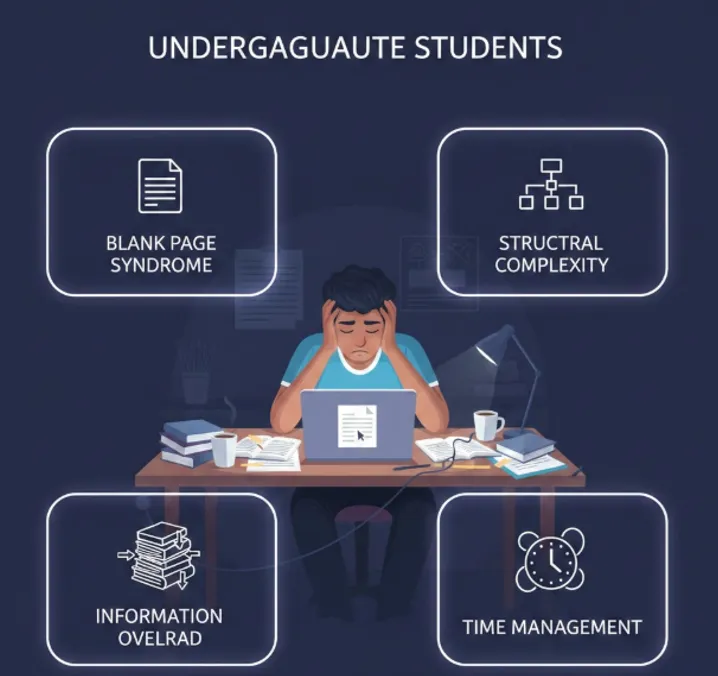
Even the most prepared students hit a wall. Writer’s block isn’t a lack of ideas; it’s usually an excess of “internal editing.” You try to make the first sentence perfect, which stops the second sentence from ever being born. This is where modern digital tools can serve as a bridge.
When you find yourself stuck in a loop of indecision, using a tool like theessay typer from Myassignmenthelp can be a game-changer for brainstorming. Rather than using it to produce a final draft, use it to see how different arguments might be structured or to spark a new direction for a paragraph that feels stale. Seeing a rough version of your ideas on the screen often provides the psychological “nudge” needed to start writing your own original, critical analysis.
Phase 3: The Importance of Criticality
In large-scale projects, “description” is your enemy, and “analysis” is your friend. Tutors aren’t looking for a summary of what others have said; they want to see how you synthesize that information.
- Question Everything: Don’t just state that a researcher found $X$. Ask why they found it and if their methodology was flawed.
- The “So What?” Factor: At the end of every paragraph, ask yourself, “So what?” How does this specific point prove your overall thesis? If it doesn’t, it’s just fluff that needs to be cut.
Phase 4: Avoiding the “Mid-Project Slump”
Around the 60% mark of any major project, boredom sets in. You’ve been living with the same topic for weeks, and it no longer feels exciting. To beat this:
- Change Scenery: If you usually work in the library, move to a quiet cafe or a different floor. A change in visual stimuli can restart your focus.
- The “Reverse Outline”: If you feel lost, read through what you’ve written and write a one-sentence summary for each paragraph. If the summaries don’t flow logically, you know exactly where your structure has gone off track.
Phase 5: The Final Polish
The difference between a 2:1 and a First Class (or a B and an A) often lies in the final 5% of effort.
- Read it Aloud: Your ears will catch awkward phrasing that your eyes will skip over. If you run out of breath reading a sentence, the sentence is too long.
- Check Your Signposting: Ensure you use “transition words” like furthermore, conversely, and notwithstanding. These act as roadmaps for your reader, guiding them through your complex thoughts.
- Consistency is Key: Ensure your referencing style (APA, Harvard, MLA) is identical from the first page to the last. Small errors in formatting suggest a lack of attention to detail, which can subconsciously lower the examiner’s opinion of your work.
Conclusion: Trust the Process
Completing a massive academic project is as much a feat of character as it is a feat of intelligence. It proves that you can set a long-term goal, manage your time, and produce something meaningful under pressure. By using the right resources, maintaining a steady pace, and utilizing supportive tools when the “blank page” gets too loud, you can cross the finish line with a piece of work you are truly proud of.
About The Author
Hi, I’m Ethan Martin, an academic consultant and contributor at Myassignmenthelp. With years of experience in higher education trends and student productivity, I specialize in helping undergraduates navigate the complexities of long-form research and high-stakes writing. My mission is to bridge the gap between daunting academic requirements and practical, actionable strategies.